Can Cats Eat Raw Rice or Dry Pasta Safely?
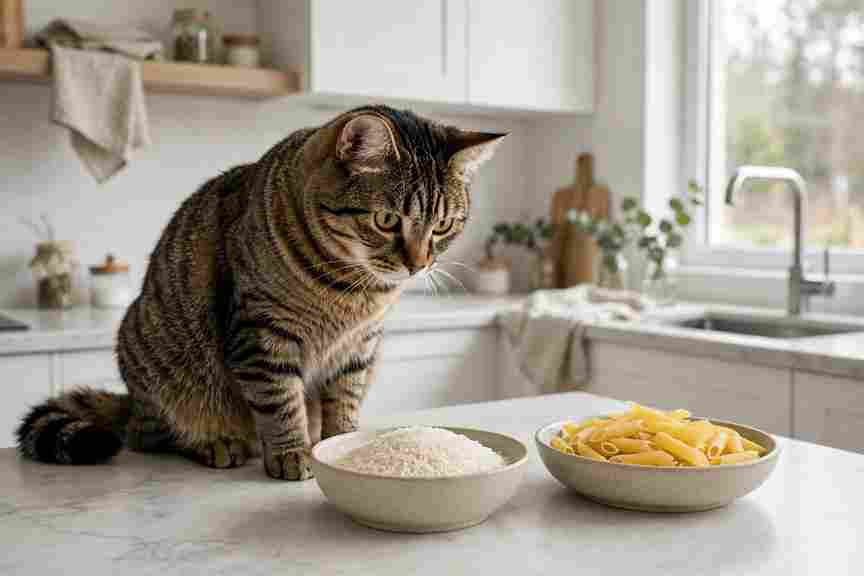
You're cooking dinner, a few grains of rice bounce off the counter, and your cat is there in half a second flat, sniffing at them like they might be treats. Or maybe a stick of dry spaghetti rolled off the pantry shelf and your cat batted it across the kitchen floor before you could grab it. Either way, you're now Googling this at 9 PM wondering if you need to worry.
Short version: a stray grain or two of raw rice, or one piece of dry pasta, is rarely a crisis. But "rarely a crisis" isn't the same as "totally fine," and the details matter more than most quick internet answers let on. This guide walks through what actually happens inside a cat's digestive system when raw rice or dry pasta shows up uninvited, when cooked versions are okay, and what warning signs mean it's time to call your vet instead of just watching and waiting.
Cats are curious in a way that's different from dogs. A dog will usually go for anything edible-looking on general principle. A cat tends to sniff first, nudge it around with a paw, maybe give it one experimental lick, and then lose interest entirely. That instinct is actually working in your favor here, since it's part of why full-blown pasta or rice binges are rare even in households where a bag gets left open on the counter overnight.
If your cat has a habit of grabbing things off counters, you might also want to check our guide on keeping your pet's teeth healthy without daily brushing — dental habits and food-grabbing behavior tend to go hand in paw. And if you haven't already, you can use our Pet Age Calculator to get a better sense of how your cat's age affects their digestion and dietary needs.
What Happens If a Cat Eats Uncooked Rice?
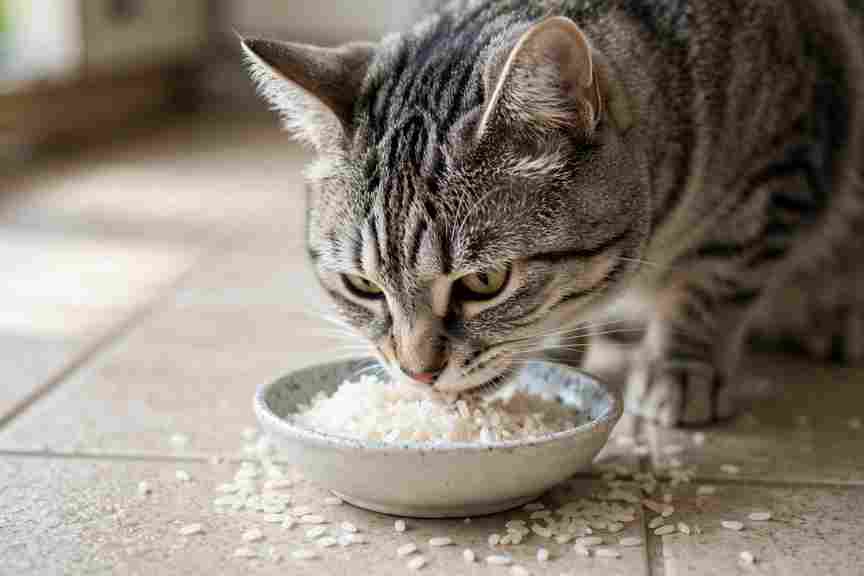
Raw rice is hard, dense, and starchy in a way that's genuinely different from the fluffy, water-softened version that ends up on your plate. Cats lack the enzymes needed to break down uncooked starch efficiently, which means raw rice sits in the stomach longer than it should.
For a single grain that got knocked onto the floor and licked up out of curiosity, the outcome is usually nothing at all. It passes through. Cats are also fairly selective eaters by nature, so most won't go out of their way to eat a bowl of dry, uncooked rice even if it's sitting right in front of them.
The concern shows up with larger quantities — say, a cat that gets into an unattended bag of rice, or one that decides a spilled cup's worth looks interesting. At that point you're looking at possible:
- Vomiting within a few hours of ingestion
- Bloating or visible abdominal discomfort
- Constipation, since raw starch absorbs moisture in the gut
- Reduced appetite for the next meal or two
None of this is usually life-threatening in a healthy adult cat. Kittens and senior cats with slower digestion are a different story, and if you've got either at home, a call to your vet after a larger accidental ingestion is worth the five minutes it takes.
Is Dry Pasta Toxic to Cats?
No — dry pasta isn't toxic in the sense that grapes or onions are toxic to cats. Plain wheat pasta, uncooked, is really just dense flour and water pressed into a hard shape. There's no compound in it that poisons a cat's system.
That said, "not toxic" doesn't mean "fine to snack on." Dry pasta is rock-hard until it's boiled, and a cat gnawing on a piece of uncooked spaghetti risks a chipped tooth more than anything else. Swallowed whole or in large pieces, longer pasta shapes like spaghetti or linguine can occasionally cause a minor choking hazard, especially in smaller or younger cats.
Where it gets trickier is flavored or boxed pasta mixes. Those often come with seasoning packets containing garlic or onion powder, both of which are genuinely dangerous to cats even in small amounts — they can damage red blood cells and lead to a type of anemia. If your cat got into a box of flavored pasta and might have licked any seasoning powder, that's worth treating more seriously than plain noodles.
Want to understand your pet even better?
Explore more science-backed pet guides and tools on Pet Age Calculator.
Visit Pet Age CalculatorCan Cats Eat Cooked Rice Instead?
This one comes up a lot, usually from owners whose vet mentioned bland rice as part of an upset-stomach recovery diet for a dog, and who are now wondering if the same trick works for cats. It sort of does, with caveats.
Plain, fully cooked white rice — no butter, no salt, no broth mixed in — is easier on a cat's digestive system than the raw version. Boiling breaks down the starch structure enough that a cat's gut can actually process it. Some vets do recommend a small spoonful mixed into a bland diet (often with boiled, unseasoned chicken) for a day or two after a bout of vomiting or diarrhea.
A few practical notes if you're trying this:
- Keep the portion small — a teaspoon or two for an average adult cat, not a full serving.
- Never add salt, butter, milk, or seasoning of any kind.
- Don't make it a habit. Rice has essentially no nutritional value for an obligate carnivore, and daily rice edges out proper protein.
- If diarrhea or vomiting lasts more than a day, rice isn't the fix — a vet visit is.
Brown rice, for what it's worth, isn't especially better for cats despite having a healthier reputation for humans. It's higher in fiber, which can actually make an upset stomach worse rather than better in the short term.
Do Cats Even Need Starch or Carbohydrates?
Here's the part that surprises a lot of new cat owners: no, not really. Cats are obligate carnivores, which is a fairly precise biological term — it means their bodies are built to run on animal protein and fat, and they don't have a dietary requirement for carbohydrates the way dogs or humans do.
That's different from saying carbs are dangerous. A cat's digestive system can process small amounts of cooked starch without much trouble. Most commercial dry cat food actually contains a fair amount of carbohydrate filler, often in the 20-40% range by weight, because it's cheaper to produce and helps hold kibble together. Cats generally tolerate this fine over a lifetime, though some vets and nutritionists argue lower-carb, higher-protein diets suit feline biology better.
Are grains bad for a cat's digestion specifically? Not inherently. Rice, oats, and corn in small, cooked, well-processed amounts aren't harmful to most healthy cats. Problems tend to show up when grains make up too much of the diet relative to actual meat protein, or when a cat has a specific grain sensitivity — which does happen, though it's less common than social media makes it sound.
There's also a popular myth worth addressing directly: grain-free cat food isn't automatically healthier just because it skips rice or wheat. Many grain-free formulas swap grains for potato, pea, or tapioca starch instead, which is still a carbohydrate source and doesn't necessarily raise the protein content. Reading the actual guaranteed analysis on the bag — protein percentage, not just the ingredient list — tells you more than the "grain-free" label on its own. If you're unsure what's right for your specific cat's age or health history, that's a conversation for your vet rather than a packaging claim.
Signs of Grain Trouble to Watch For
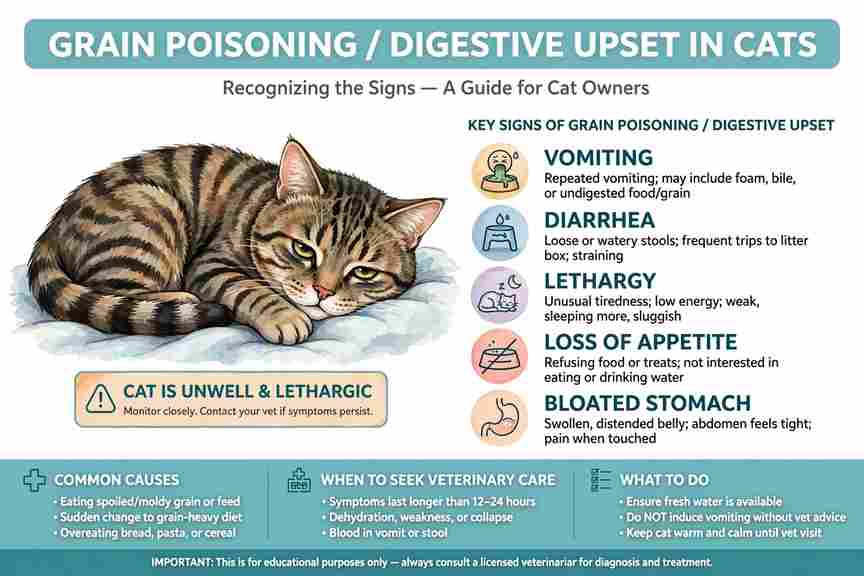
Accidental ingestion of raw food — rice, pasta, flour, dough — is one of the more common reasons cat owners end up calling an emergency vet line on a weekend. Raw bread dough is actually the bigger danger in this category, since yeast continues to expand and ferment inside a warm stomach, which is a genuine emergency. Plain raw rice and dry pasta are much lower-risk, but it still helps to know what "something's wrong" looks like.
Call your vet, or an emergency clinic if it's after hours, if you notice any of the following after your cat gets into rice, pasta, or other starchy food:
- Repeated vomiting, especially more than once within a few hours
- Diarrhea lasting more than 24 hours
- A visibly swollen or hard abdomen
- Straining to defecate, or no bowel movement for over 48 hours
- Unusual lethargy, hiding, or refusing food and water
- Drooling or pawing at the mouth, which can point to a piece of hard pasta lodged near the teeth or throat
Most of the time, a single small incident resolves on its own within a day. The signs above matter mainly for larger accidental ingestions — a whole bag knocked over, a full box of pasta gnawed through — not a stray grain licked off the floor.
Other Safe Human Foods for Cats
Since you're already thinking about what's safe to share, it helps to know the wider list. These are generally fine in small, occasional amounts for a healthy adult cat:
- Plain, boiled chicken or turkey (no skin, no seasoning)
- Small pieces of cooked, plain fish like salmon (not raw, and not daily due to mercury concerns)
- A little plain, cooked pumpkin — genuinely useful for firming up loose stools
- Cooked eggs, fully set, no salt or butter
- Small amounts of cooked carrot or green beans, cut small
Keep every "treat" food to well under 10% of a cat's daily calories. Their main diet should still come from a complete, protein-focused cat food, and none of the items above are a substitute for that.
What to Do Right After It Happens
Say you walk into the kitchen and find an empty pasta box on the floor, cat nowhere in sight, looking suspiciously smug. Here's a reasonable order of steps instead of panicking straight to an emergency clinic.
- Try to estimate how much is actually missing. A third of a box is a very different situation than three noodles.
- Check whether it was plain pasta or a seasoned mix. Flip the box over and read the ingredients if you still have it.
- Note the time. If symptoms show up later, your vet will want to know roughly when the ingestion happened.
- Watch, don't force anything. Don't try to induce vomiting at home — it's not usually necessary for plain rice or pasta, and doing it wrong can cause more harm than the food itself.
- Call your vet if it was a large quantity, a seasoned product, or if your cat is a kitten, senior, or has an existing digestive condition.
For most households, this ends with nothing more dramatic than a slightly upset stomach and a cat who's a little more closely supervised around the pantry for a while. It won't always go that smoothly, though — if your cat already has a sensitive stomach or a history of pancreatitis, even a "minor" incident is worth a same-day call rather than a wait-and-see approach.
Quick Recap Table
| Food | Safe in Small Amounts? | Main Risk |
|---|---|---|
| Raw rice (a few grains) | Usually yes | Mild digestive upset in larger amounts |
| Dry pasta (plain) | Usually yes | Chipped tooth, minor choking risk |
| Cooked white rice, plain | Yes, occasionally | Low nutrition, shouldn't replace meals |
| Flavored/seasoned pasta mixes | No | Garlic/onion powder toxicity |
| Raw bread dough | No | Dough expansion and alcohol toxicity — emergency |

Frequently Asked Questions
Can cats eat cooked rice?
A small amount of plain, fully cooked white rice is generally safe as an occasional addition, particularly if a vet has recommended it for an upset stomach. It shouldn't replace a meal and shouldn't be seasoned.
Is dry pasta toxic to cats?
Dry pasta isn't toxic in the way chocolate or onions are, but it's hard, starchy, and offers no real nutrition for a cat. A stray piece batted off the counter usually isn't an emergency, though a large amount can cause digestive upset or a choking hazard.
What happens if a cat eats uncooked rice?
A few grains of raw rice will likely just pass through or cause mild gas. Larger amounts are harder for a cat to digest than cooked rice and can lead to vomiting, bloating, or firm stools.
Can cats eat starch or carbohydrates?
Cats can digest small amounts of cooked starch, but they are obligate carnivores without a biological need for carbohydrates. Diets heavy in starch instead of animal protein aren't a good long-term fit for feline health.
What are the signs of grain poisoning in cats?
Watch for vomiting, diarrhea, lethargy, loss of appetite, or visible abdominal discomfort after a cat eats a large quantity of grain-based food. These symptoms usually point to digestive irritation rather than true poisoning, but persistent signs need a vet visit.
If you're regularly finding your cat nosing around spilled rice or pasta, it's usually just boredom or curiosity rather than a nutritional craving — a food puzzle toy or a bit more playtime often solves it faster than any dietary change. For more guides like this one, check out the rest of our blog.